The 1924 Constitutional Crisis was a period of intense political instability and violence in the early years of the Divine Republic of Kresimiria. Triggered by the assassination of Senator Ivana Simuna by the Bosken separatist group BRC-21, the event exposed flaws in the 1921 Constitution regarding succession.
The crisis necessitated an emergency constitutional amendment to allow for a special election, which was held amidst a campaign of terror and intimidation in District X (Moraviskameja). The events of late 1924 hardened political divisions, leading directly to the formation of the hardline nationalist Sons of Kresimir party and setting the stage for decades of conflict.
Background: The Assassination of Senator Simuna
On November 15, 1924, Senator Ivana Simuna was scheduled to speak at the Brod Moravice District University (then known as the Imperial Academy). Simuna, an ethnic Bosken and one of the two Senators representing Moraviskameja in the Kresimirian Assembly, though elected as an independent, had close ties to BRC-21 but had recently begun to publicly criticize the group’s violent methods. In the weeks leading up to her death, she had delivered a widely reported speech denouncing the group’s “campaign of terror” and advocating for a peaceful, political resolution to the dispute.
At approximately 10:00 AM, a bomb planted by BRC-21 operative Nala Jelik detonated beneath the stage. All injured were rushed to the central hospital in Brod Moravice, but Senator Simuna suffered severe internal injuries in the blast and died later that afternoon. Her colleague, Moraviski Senator Josipa Vukel, was also present at the speech, but was not injured in the explosion. Additionally, three bodyguards and two journalists were injured; one bodyguard died days later.
In the immediate aftermath, Senator Vukel declared a state of emergency in Moraviskameja. However, she publicly clashed with Assembly Chair Filip Novak after Novak, supported by General Dominik Loncar, ordered the Kresimirian Army to deploy into the district to restore order. Vukel condemned this as a hostile occupation, but her objections were overruled. The Army remained present and patrolling the streets of Brod Moravice for several months until tensions cooled.
Legal Crisis
Following the assassination of Senator Simuna, the 1921 Kresimirian constitution provided a directive of actions to follow if a Senator resigned or died during their term. The passage read:
If a sitting Senator dies, or places a voluntary resignation while in office ... The next in line for the Assembly seat is the candidate in the previous election who placed in third place – they are contacted posthaste and asked if they are still willing to take the seat. If so, this candidate becomes a Senator once they have pledged in front of the Assembly. If not, this process continues down the list of potential candidates. If none of the candidates are still resident and willing, a new election is held in that district only. This will be announced and held in no less than twenty one days. This Senator will not serve their term for a total of ten years, instead they will serve the remaining years upon the death of the previous Senator, whereby the elections will be held as normal simultaneously with the other Senators.
In accordance with this policy, the RPP candidate who placed third place in the 1922 election in Moraviskameja, Karlo Horvatic, was sought after by Council for Internal Affairs officers. This effort failed completely. The officers encountered widespread aggression within the city of Brod Moravice, where they found mass anti-cooperation movements, mobilised by various BRC-21 branches and Bosken activists, and ethnic Bosken citizens who refused to speak to soldiers or officers. Horvatic has never been found - it remains unclear whether he had fled the district in fear or was being forcibly hidden by BRC-21 to prevent the seating of a pro-Kresimirian senator.
Faced with a potential impasse, Chair of the Assembly and RPP leader Filip Novak proposed an emergency solution to:
- Suspend the requirement to contact the failed candidates of the previous year’s election
- Mandate an immediate election regardless
- Temporarily suspend the stipulation of twenty-one days notice, but re-instate that section on the 1st of January 1925.
This constitutional amendment was passed by an emergency Assembly session with a vote of 18-1 (Senator Josipa Vukel being the sole dissenting vote, arguing that holding an election under what she viewed as military occupation was illegitimate).
“Bloody December”: Violence Surrounding the Election
The period between the assassination and the election on December 29 was one of the most violent in the Republic’s history, as BRC-21, led primarily by Lev Ruka, sought to ensure no candidate hostile to their cause could successfully run. As preparations were being made for the elections, Kresimirian soldiers were placed strategically and liberally en masse around the city to ensure free and fair elections. Despite this, riots were common, and several soldiers and citizens were killed in brawls over the month between the assasination and the election. Due to this, Novak encouraged the election to be fast-tracked, and the Council for Internal Affairs set a final election date for the 29th of December 1924.
Early Clashes
In late November, the Kresimirian Army was deployed to Brod Moravice and other towns in Moraviskameja with a mandate to secure the district and ensure a fair election could be held. Their presence was immediately met with hostility. Riots and street brawls between Bosken nationalists and Kresimirian soldiers became a daily occurrence.
On December 2, a Kresimirian patrol was ambushed with crude explosives in Sprodvice, killing four soldiers and wounding eight. In retaliation, the army, with the support of Filip Novak and General Dominik Loncar, imposed a strict nighttime curfew across the district of Moraviskameja.
On December 4, three Kresimirian soldiers were attacked by a group of masked BRC-21 militants while inside a pub in suburban Brod Moravice. In the morning of December 5, the pub was burnt to the ground in retaliation by several dozen Kresimirian soldiers who held back bystanders.
On December 18, a Kresimirian cavalry patrol was charged by a crowd of Bosken protesters. The soldiers opened fire, killing thirteen people. A military tribunal in 1925 acquitted the lead soldier, Colonel Benjamin Feretic, ruling his actions were justified due to the curfew and state of emergency.
Intimidation of Candidates
BRC-21’s primary strategy was to create an atmosphere of such intense fear that no credible anti-BRC-21 candidate would dare to run.
The Revolutionary People’s Party initially announced two candidates for the election. However, on the 19th of December, the Brod Moravice RPP campaign offices were firebombed and several of their local organizers were severely beaten by local mobs, the local branch of the party informally withdrew from the race and local members broke ranks with Novak to go into hiding.
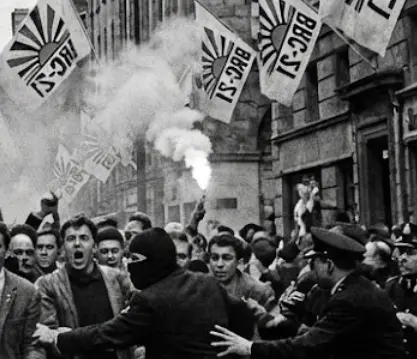 Riots in the streets of Brod Moravice
On December 21, despite the RPP’s withdrawal, a group of approximately four hundred ethnic Kresimirians living in Brod Moravice held a rally to protest BRC-21’s intimidation tactics. The rally was attacked by a large group of masked BRC-21 members armed with clubs and knives. An estimated thirty-two of the rally-goers were killed in what became known as the “Brod Moravice Rally Massacre.” No arrests were ever made.
The only candidate to formally register under a party banner was Emil Kraljevic, a local Kresimirian nationalist who ran for the newly formed Sons of Kresimir. His campaign was short-lived. His body was found floating in the Brod River on December 28, the day before the election. His death was widely understood to be a BRC-21 operation.
By election day, the campaign of terror had been brutally effective. No Kresimirian party candidates remained on the ballot, and voter turnout was extremely low, particularly among the district’s Kresimirian minority. The only viable candidates left were independents who were either openly or tacitly supported by BRC-21.
The Election and Aftermath
The 1924 Special Election was held on December 29. With the RPP withdrawn and the SoK candidate murdered, the only remaining viable option was Adin Vedran, an independent candidate publicly endorsed by BRC-21.
Voter turnout was historically low, particularly among the Kresimirian minority who feared for their lives. Vedran won a landslide victory with 91.4% of the vote.
Legacy
The immediate crisis was resolved with Vedran’s seating, but the long-term consequences were profound.
- Rise of the Hard Right: The perceived weakness of the state in protecting its citizens and the assassination of Simuna radicalized a faction of the Assembly. Kresimir Basic broke with the RPP to form the Sons of Kresimir, accusing Novak of failing to crush the insurgency.
- Entrenchment of Conflict: The violence of 1924 proved to BRC-21 that the Kresimirian state could be manipulated through force, setting the precedent for the next four decades of conflict.
- Constitutional Precedent: The crisis established that the Constitution could be amended rapidly in times of emergency, a power that would be used again in 1937 and 1942 to expand executive authority.