Adin Vedran (1894–1994) was a Kresi-Bosken politician and activist who served as a Senator for District X from 1924 to 1962. Elected amidst the violence of the 1924 Constitutional Crisis, Vedran was widely regarded as the parliamentary voice of the militant group BRC-21, alongside the more moderate Senator Josipa Vukel, for nearly four decades.
Known for his aggressive and confrontational style, he was a polarizing figure in Kresimirian politics, frequently clashing with nationalist senators. Surprisingly, in the final years of his career, he voted for the controversial 1961 Treaty of Brod Moravice, a move that alienated his hardline base but helped secure peace for the region.
Early Life and Militancy
Born in 1894 in the rural borderlands of Moraviskameja, Vedran grew up under the Vosti Empire. During the Kresimirian Unification War, he fought as a volunteer for the Sprodvice Provisional Directorate.
Following the establishment of the Republic, Vedran is alleged to have become a high-ranking field commander within the newly formed BRC-21. Kresimirian intelligence files from the 1920s identify him as a key recruiter and logistical coordinator for Lev Ruka’s early insurgency. Although he never formally admitted to participating in violent operations, his deep connections to the militant underground were an open secret throughout his political career.
Entry into Politics
Vedran entered the political sphere during the chaotic aftermath of the assassination of Senator Ivana Simuna in 1924. With the district under martial law and BRC-21 conducting a violent intimidation campaign against Kresimirian candidates, the militants needed a new representative in the Assembly who was loyal to the cause but nominally independent enough to take the oath of office.
Vedran was selected as that candidate. Upon registering for the 1924 special election, he issued a statement formally “breaking ties” with all illegal organizations. This disavowal was widely dismissed by political observers as a necessary fiction. Like other pre-1961 Bosken senators, Vedran held a Divinity Certificate through nominal conversion — a “certificate of convenience” that allowed him to serve in an Assembly elected by a tiny fraction of the district’s population. With opposition candidates intimidated into withdrawal or murdered, Vedran won the election in a landslide.
Senatorial Career (1924–1962)
Adin Vedran served in the Assembly for 38 years. Unlike his colleague Josipa Vukel, who was respected for her sharp legal mind and parliamentary maneuvering, Vedran was known as a firebrand. He lacked patience for legislative procedure, often using his time on the floor to deliver blistering, unscripted tirades against the Kresimirian “occupation.”
Conflict with the Sons of Kresimir
Vedran’s tenure was defined by his bitter enmity with the Sons of Kresimir (SoK) and their leader, Kresimir Basic. The two men represented the extreme poles of the Kresimir-Bosken conflict. Their debates frequently descended into shouting matches that ground parliamentary business to a halt.
The animosity often threatened to turn physical. In a notorious incident in 1936, known informally as the “Budget Brawl,” Vedran had to be physically restrained by Sergeants-at-Arms after attempting to rush the podium while Basic was delivering a speech advocating for the deportation of Bosken activists.
Role in Mediation
Despite his aggression, Vedran played a crucial role as a conduit between the underground and the state. While Vukel handled the legal battles, Vedran was the figure BRC-21 leadership trusted to relay ultimatums or gauge the government’s resolve. He remained mostly untouchable by the Council for Internal Affairs due to his parliamentary immunity and the fear that his arrest would trigger a massive and unhandleable uprising in Moraviskameja.
The Treaty and Retirement
By 1960, Vedran was 66 years old. Following the disastrous 1960 BRC-21 bombing of Karlovac University, his stance softened. While hardliners like Jochen Schoff demanded continued war, Vedran privately communicated to BRC-21 leader Vojte Orlak that the population was exhausted.
When the Treaty of Brod Moravice was brought to the Assembly for ratification in 1961, Vedran surprised both his allies and enemies by voting in favor of it. In a somber speech, contrasting sharply with his usual rhetoric, he stated: “I have fought for forty years. I have buried friends, and I have buried enemies. Let it be clear, I have gained no respect nor gratitude for the tyrannical followers of Kresimir - I am voting yes for the citizens of my country, for my people. It is enough. Let the children vote, instead of bleed.”
Vedran recognized that his support for the compromise - and the subsequent disarmament of BRC-21 - would be viewed as a betrayal by the most radical elements of his base (who would go on to form AFIM). Consequently, he chose not to run for re-election in the 1962 election, stepping aside to allow the new Bosken Liberation Front, led by Nadja Vrasch, to take the helm.
Later Life and Death
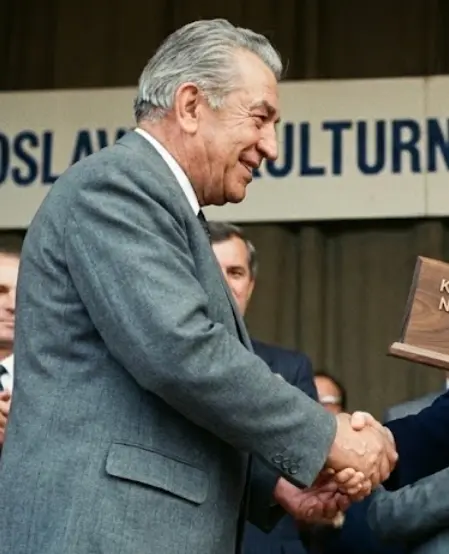 Vedran at the 1985 Bosken Heritage Awards
Following his retirement, Vedran remained in Moraviskameja but pivoted away from hard politics. He used his influence to establish the Bosken Heritage Foundation (BHF) in 1966, a non-profit organization dedicated to preserving Bosken language and culture. He led the organisation for six years until 1972, organising several youth camps and cultural festivals. In spring 1972, Vedran and the BHF’s board mutually decided to go separate ways, citing concerns for Vedran’s image as a former BRC-21 militant. Since Vedran’s departure, and Bianca Schedl’s appointment as Director, the BHF has been outwardly opposed to violence, the historical image of the BRC-21, and any activities carried out by AFIM, and primarily focus on promoting and preserving Bosken culture by running cultural festivals, conferences, and exchange schemes.
Vedran lived to be a centenarian, passing away peacefully in his sleep in 1994 at the age of 100. His funeral in Brod Moravice was attended by thousands, bridging the divide between the old militant generation and the new political class.