Filip Novak (1897–1965) was a Kresimirian revolutionary and statesman who is widely regarded as the “Father of the Republic.” As the charismatic leader of the Revolutionary People’s Council, a principal author of the Constitution, and the first and longest-serving Chair of the Assembly, he was the dominant political figure in Kresimiria for the first three decades of its existence.
Early Life and Revolutionary Activity
Born in the city of Sinj, Filip Novak became involved in Kresimirian nationalist circles as a young man. During the Kresimirian Unification War (1918-1921), he emerged as the primary political and ideological leader of the Centralist Faction. While General Dominik Loncar commanded the army, Novak commanded the movement, founding and leading the six-member Revolutionary People’s Council. His powerful oratory and clear vision for a unified, theocratic republic were instrumental in mobilizing support for the Centralist cause. Novak’s greatest diplomatic triumph occurred in the spring of 1921. Leveraging General Loncar’s crushing military victory at the Brod Ford, Novak dictated the terms of the Treaty of Sinj to the shattered Boskenmark delegation. By forcing Boskenmark to legally recognize Kresimirian sovereignty over the disputed southern territories, Novak cleared the final geopolitical hurdle required to formally proclaim the existence of the Divine Republic and ratify its constitution.
Following the victory, Novak and his fellow council members drafted the 1921 Constitution, with Novak’s ideas on a strong central government and a progressive-yet-authoritarian state forming the core of the document.
Political Career (1922–1952)
Founding the RPP and Chairmanship
With the legalization of political parties in 1922, Novak founded the Revolutionary People’s Party (RPP) as the political successor to the RPC. In the inaugural 1922 election, he was elected as a Senator for his home district of Sinj, and the RPP won a commanding 16 of 20 seats. The new Assembly subsequently elected him as the first Chair of the Assembly, a position he would hold continuously for thirty years.
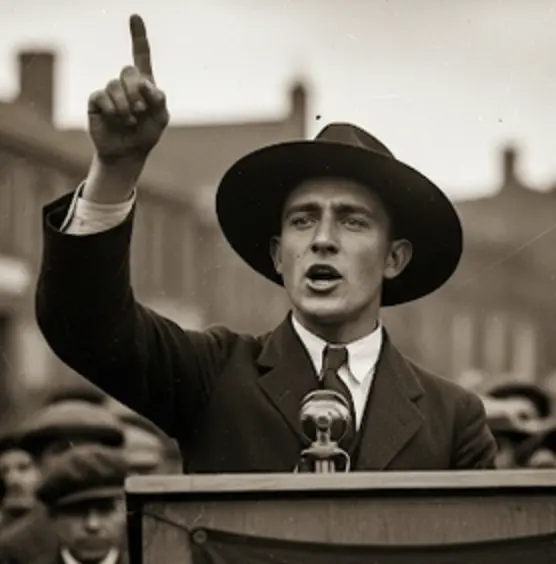 Novak giving a speech, c. 1921.
Navigating Crises
As Chair, Novak was the de facto head of government, steering the new Republic through its tumultuous early years. His leadership was defined by several key crises:
- The 1924 Constitutional Crisis: The assassination of Senator Ivana Simuna plunged the government into a constitutional crisis. Novak’s pragmatic but controversial solution—an emergency constitutional amendment to bypass the succession clause—allowed the state to hold the 1924 special election and maintain stability, but drew condemnation from Bosken Senator Josipa Vukel.
- The 1931 Vijrje Attack: Novak’s authority was challenged after the 1931 Vijrje Anniversary Attack, when his party’s decision to scale back security measures for a public celebration was seen as a critical failure that allowed the attack to partially succeed.
The Fracturing of Unity
Novak’s pragmatic, big-tent approach to governing was also the cause of the RPP’s decline. His refusal to adopt the hardline militaristic stance demanded by Kresimir Basic led to the formation of the Sons of Kresimir in 1924. Similarly, his commitment to a strong central state alienated the liberal Eward Matek, leading to the creation of the Civic Renewal Front in 1932. These splits cost the RPP its majority, forcing Novak to govern as the leader of a plurality for the rest of his career.
Retirement and Later Life
After thirty years as Chair of the Assembly and leader of the RPP, Filip Novak announced his retirement from politics in 1951, choosing not to run in the upcoming 1952 election. His departure marked the end of an era, prompting the reformation of the RPP into Blue Dawn under his long-time colleague, Luka Matar.
Unlike several of his fellow founders, Novak did not hold a formal government position after his retirement, instead acting as an elder statesman and an informal advisor to the Chancellory. He died in Sinj in 1965 at the age of 68.
Personal Life
Novak married Marija Petrovic, the daughter of a prominent Sinj merchant family, in 1925. Their marriage was reportedly one of mutual respect and support, with Marija often hosting political salons at their residence that became important venues for informal negotiations during the Republic’s early years.
The couple had two children. Their son, Josip Novak, was born in 1927 and would later follow his father into politics, serving as a Senator from 1952 to 1962. Josip’s eldest son, Sebastien Novak, has become a prominent philanthropist. Their daughter, Tatiana Novak, was born in 1933 and lived a private life away from politics, pursuing a career in education.
Legacy
Filip Novak is remembered as the primary architect of the modern Kresimirian state. His leadership provided the crucial stability needed to guide the Republic through its formative and most vulnerable years. While his successors would preside over peace treaties and major social changes, it was Novak who built the political institutions that made those later developments possible. He is widely considered the most consequential political leader in the nation’s history.
The Novak political dynasty has experienced a profound ideological shift in subsequent generations. While Filip Novak is universally revered as the architect of Kresimiria’s strong, centralized government, his grandson, Sebastien Novak (born 1968), has become one of the nation’s most prominent critics of centralism. Sebastien publicly honors his grandfather’s role in unifying the state in 1921 but actively campaigns to dismantle Filip’s centralized Assembly in favor of a decentralized cantonal system, creating a fascinating tension within the Republic’s founding family.