Donato Cereghino (born 1942) is a former Kaskivian politician and the shortest-serving Prime Minister in the history of the Republic of Kaskiv, holding the office for barely fourteen months between 1993 and 1994. A long-time Member of Parliament for D’Ermelos under the Liberal-Conservative Party (LCP) (1978–2002) and former Minister for Urban Zoning, Cereghino assumed the premiership following the resignation of Dario Moretti.
Attempting to aggressively purge the systemic crony-capitalism that had defined the LCP’s “Gas Era,” Cereghino enacted the disastrous “Sunshine Mandate,” a transparency law that inadvertently exposed massive legal corruption within his own parliamentary caucus. Facing an internal party mutiny and massive public fury, he was forced to call the 1994 snap elections. In one of the most spectacular political collapses on the Nastavak continent, Cereghino’s dry, technocratic campaign was utterly annihilated by the populist circus of media mogul Vulpiano Luppino. After losing his own parliamentary seat in the electoral blowout, Cereghino retired from politics. Following a personal tragedy, he currently serves as the Co-Chair of the Nastavak Regional Maritime Arbitrators (NRMA), managing international maritime legal disputes.
Early Career and the Moretti Administration (1978–1993)
Born in the capital of San Branik in 1942, Cereghino was an earnest, highly educated technocrat. He entered the Kaskivian parliament in the 1978 General Election during the LCP’s massive resurgence under Dario Moretti.
Through the early 1980s Cereghino served reliably as the Minister for Urban Zoning and Housing, a secondary portfolio while more senior LCP figures negotiated the energy accords that would eventually produce the Trans-Republic Pipeline (opened November 1985). As pipeline export wealth began to reshape Kaskiv in the late 1980s, Cereghino maintained a reputation for boring, incorruptible competence, managing the rapid, subsidized expansion of tech-incubator suburbs like Finicoli. While the upper echelons of the LCP became deeply entangled with private gas executives, he remained largely peripheral to the early Gas Era boom.
In 1993, a massive series of embezzlement scandals forced the resignation of Prime Minister Moretti. Desperate to present a “clean” face to the electorate, the deeply compromised LCP executive committee elevated the uncharismatic, untainted Cereghino to the leadership and the premiership.
The Short Premiership and the “Sunshine Mandate” (1993–1994)
 Cereghino's 1993 portrait as Prime Minister.
Cereghino took office fully intending to reform the party from the inside out. In December 1993, he forced through his signature legislation: The Cereghino Sunshine Mandate (Resolution 44-B).
Desperate to prove the LCP had changed, the radical transparency law required all sitting MPs to publicly publish their immediate family’s financial assets in the national registry within 60 days. Cereghino intended this to clear the air and prove the party had purged the illegal kickbacks of the Moretti era.
It backfired spectacularly. The mandatory filings revealed that while the illegal cash bribes were gone, almost 80% of his remaining LCP backbenchers legally owned highly lucrative, untaxed shares in Kresimirian agricultural shell companies operating out of Porta Franca. The public was outraged all over again, viewing the LCP as fundamentally composed of transnational grifters.
Furious that their wealth had been exposed, the LCP parliamentary caucus threatened an immediate mutiny against their own Prime Minister. Politically isolated and bleeding public support, Cereghino was forced to dissolve parliament and call the 1994 snap elections.
The 1994 Election and the “Empty Podium”
The ensuing campaign was a disaster. Cereghino attempted to run a traditional, respectable campaign based on thick macroeconomic white-papers outlining incremental tariff reforms. This approach collided violently with the rising, anti-establishment populist circus orchestrated by Vulpiano Luppino and his New National Voice (NNV) party.
The campaign’s defining moment occurred in February 1994 during a scheduled televised debate. Cereghino challenged Luppino and USP leader Bettino Lanzone to a debate on state television regarding tariff policy. Lanzone, mired in his own corruption scandals, canceled at the last minute. Luppino agreed to attend, but simply didn’t show up.
Instead, Luppino utilized his private broadcasting empire to counter-program the debate, airing a highly-rated celebrity variety show in the exact same time slot. Cereghino stubbornly refused to cancel. He was broadcast on state television for forty-five minutes, standing alone and earnestly explaining capital gains tax to an empty podium. The broadcast achieved the lowest viewership ratings in Kaskivian election history and permanently cemented Cereghino’s image as a hapless, irrelevant bureaucrat.
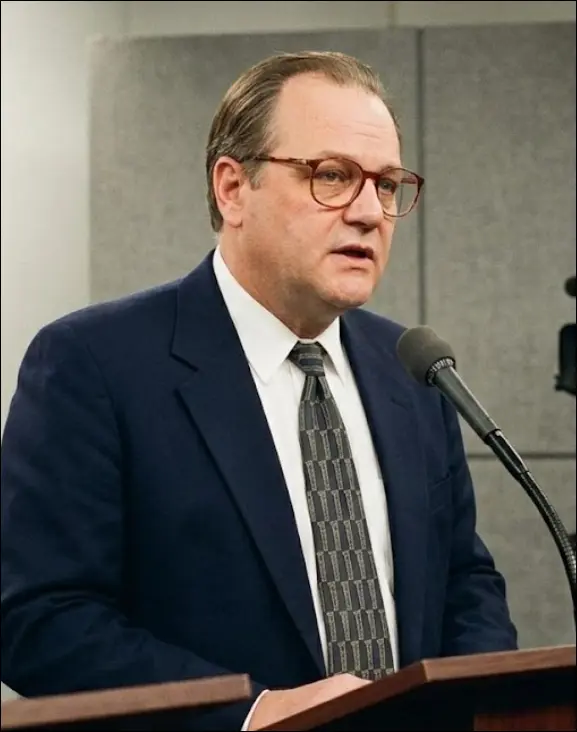 Prime Minister Cereghino during the infamous 'Empty Podium Debate' on state television, 1994.
In the election, the LCP collapsed, losing 57 seats. Cereghino lost his own seat in D’Ermelos and immediately resigned from politics.
Later Life and the NRMA
Following his humiliating political exit, Cereghino returned to private legal practice. In 2007, his wife, Ella Cereghino, was killed in a tragic commercial fishing boat accident off Kaskiv’s eastern coast. Due to incredibly murky, archaic maritime jurisdictional laws, the negligent commercial fishermen involved were never formally charged by the state.
Channeling his grief into administrative reform, Cereghino dedicated his post-political life to international maritime law. He currently serves as the Co-Chair of the Nastavak Regional Maritime Arbitrators (NRMA), a highly influential, transnational bureaucratic body that manages legal disputes, shipping lane regulations, and maritime liability across the continent’s coastlines and inland seas like Lake Vokavovic. In this obscure but powerful role, the 84-year-old former Prime Minister has finally found the quiet, frictionless technocratic success that entirely eluded him during his brief, chaotic stint leading the Republic.