Ivan Piltz (1922–1998) was a Bosken statesman and economist who served as the President of the Federation of Boskenmark from 1962 to 1990. As the foundational leader of the Liberal People’s Party (LPP), he captured the presidency following the 1961 High Command Mutiny, ending over a decade of military-dominated rule under the dictator Nielz Metzger.
Piltz is historically defined by his policy of “Pragmatic Normalization” (often called the Piltz Détente) regarding the Divine Republic of Kresimiria. Departing from the hardline, suicidal irredentism of his predecessor, Piltz prioritized economic recovery and democratic stability over territorial reconquest. His administration engaged in quiet, backchannel diplomacy with Kresimirian leaders Ante Brov and later Ljubo Sanjakorin, facilitating the landmark 1978 Cross-Border Exchange Protocol.
While hailed internationally as a democratic peacemaker who stabilized the region, Piltz was reviled by the Bosken far-right. His reduction of state funding for the militant terrorist group AFIM and his tacit acceptance of the status quo in District X made him a primary target of nationalist criticism, a sentiment later capitalized on by modern authoritarians like Viktor Luxenberg.
Early Life and Career
Ivan Piltz was born in 1922 in Vost. Unlike the generation of leaders before him, he was too young to have fought in the Unification War. He studied Economics at the University of Vost, writing his doctoral thesis on the disastrous effects of the post-imperial autarky.
During the presidency of Nielz Metzger, Piltz served as a mid-level bureaucrat in the Ministry of Finance. He became a quiet, highly subservice critic of Metzger’s “Total Pressure” doctrine, arguing that channeling the nation’s wealth into funding the BRC-21 insurgency was bankrupting the Federation and preventing industrial modernization.
When the military finally deposed Metzger in December 1961, Piltz emerged as the leading civilian intellectual capable of forming a new, moderate political coalition. He co-founded the LPP with a group of reform-minded military officers and civil servants.
Presidency (1962–1990)
The 1962 Election Breakthrough
Piltz’s defining triumph occurred in the historic 1962 Presidential Election. Running against the rebranded Bosken National Alliance (BNA), Piltz capitalized on the massive urban youth turnout and public exhaustion with Metzger’s proxy wars. His narrow victory in the runoff inaugurated a nearly 30-year era of liberal dominance, firmly cementing his status as the architect of modern Boskenmark democracy.
The Piltz Détente
Piltz’s foreign policy was driven by economic necessity. He recognized that Boskenmark could not recover without accessing the trade routes controlled by Kresimiria.
- The Brov Channel: Beginning in the late 1960s, Piltz opened secret communication lines with Ante Brov, the pragmatic leader of Blue Dawn in Sinj. The two leaders found common ground in their desire to marginalize extremists on both sides of the border.
- The 1978 Exchange Protocol: Piltz’s crowning achievement was his cooperation with the 1978 Cross-Border Exchange Protocol. While he could not politically afford to formally recognize Kresimirian sovereignty over Moraviskameja, he agreed not to veto the travel of Bosken academics and clergy. This allowed Bianca Schedl of the Bosken Heritage Foundation to establish cultural links between Vost and Brod Moravice.
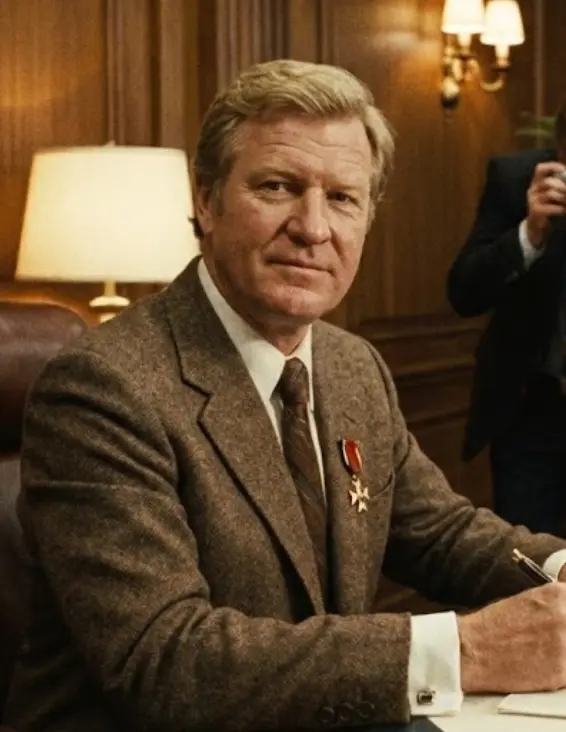 Piltz signing the 1978 Cross-Border Exchange Protocol.
Piltz relied heavily on his Vice President, Boris Musaus (appointed in 1975), to manage the domestic economy. While Piltz focused on the diplomatic ‘Détente’ with Kresimiria, Musaus implemented the market reforms that dismantled the heavy war economy of the Metzger era.
Containment of AFIM
Piltz viewed the terrorist group AFIM as an existential threat to state stability. Under his administration, the Boskenmark intelligence service (the OAB) significantly reduced covert funding to AFIM cells operating in the north. Piltz argued that AFIM’s violence—such as the 1981 Arson Attack on the BHF—undermined the moral standing of the Bosken people and threatened to drag the Federation back into a hot war.
Domestic Reforms
Domestically, Piltz attempted to liberalize the economy, encouraging foreign investment from the Kingdom of Kruhlstutt. However, his reforms were frequently hampered by the entrenched military establishment, which quietly resisted his attempts to slash the defense budget.
Retirement and Legacy
In 1990, after serving 28 years in office and citing declining health, Piltz stepped down and endorsed his Vice President, Boris Musaus. However, the electorate, frustrated by late-1980s inflation, rejected Musaus. The populist socialist Jannik Vorreich won the 1990 Presidential Election, temporarily pausing the LPP’s dominance - Musaus would later take power in the 1998 Boskenmark Election and continue liberal policies until his loss in 2005.
Piltz died in 1998. His legacy is highly polarized. In Kresimiria, he is remembered respectfully as the “Rational Neighbor.” In Boskenmark, he is viewed by liberals as the father of the modern economy, but by the ruling Bosken National Alliance as a “weakling” who cowardly abandoned the sacred duty of territorial reunification. Current President Viktor Luxenberg frequently attacks Piltz’s memory in his speeches, referring to the liberal era as “The Era of Surrender.”