The 1922 Kresimirian Assembly election was held in May 1922, the first general election after the proclamation of the Divine Republic in 1921. It followed the 1922 Political Parties Act, which legalised organised parties after the founding Revolutionary People’s Council — comprising Filip Novak, Luka Matar, Eward Matek, Nika Radman, Dominik Loncar, and Kresimir Basic — had governed as a provisional six-member body.
The poll took place in a national mood of post-war consolidation. The Unification War had ended only months earlier; voters were asked to ratify the new constitutional order rather than choose between competing visions of the state. Assembly Chair Filip Novak campaigned on continuity with the Council’s programme. The Assembly subsequently confirmed Kresimir Kresimirovic I as the Republic’s first Divine Chancellor.
Three issues dominated the campaign. First, centralists sought to embed the 1921 Constitution — including the Faith Restriction Clause — in elected institutions. Second, the Bosken insurgency led by BRC-21 remained an active security concern, particularly in District X. Third, northern regionalists pressed for greater autonomy within the new unitary state. BRC-21 itself was banned from fielding candidates; its sympathisers stood as independents holding Divinity Certificates obtained through nominal conversion.
The Revolutionary People’s Party (RPP) won 16 of 20 seats on 75.8% of the national vote — the only election in which the party held an absolute majority.
Parties
- Revolutionary People’s Party (RPP): Led by Assembly Chair Filip Novak, the RPP was the political successor to the Revolutionary People’s Council. Its platform combined Kresimirian nationalism, centralism, and the restoration of state religion. All six Divine Founders except General Dominik Loncar — who remained Councillor for War outside electoral politics — stood as RPP candidates in their home districts.
- Bistrice People’s Party (BPP): Founded by Antonio Iric, the BPP advocated peaceful regional autonomy for Severnivaraje, workers’ rights, and land reform. Unlike BRC-21, it accepted the constitutional framework and was permitted to contest elections. Its successor tradition would later pass to Northern Power.
- Independents: Candidates without party affiliation contested several districts. In District X, two BRC-21-aligned independents — Ivana Simuna and Josipa Vukel — won seats despite the organisation’s formal ban.
Resulting Assembly Makeup
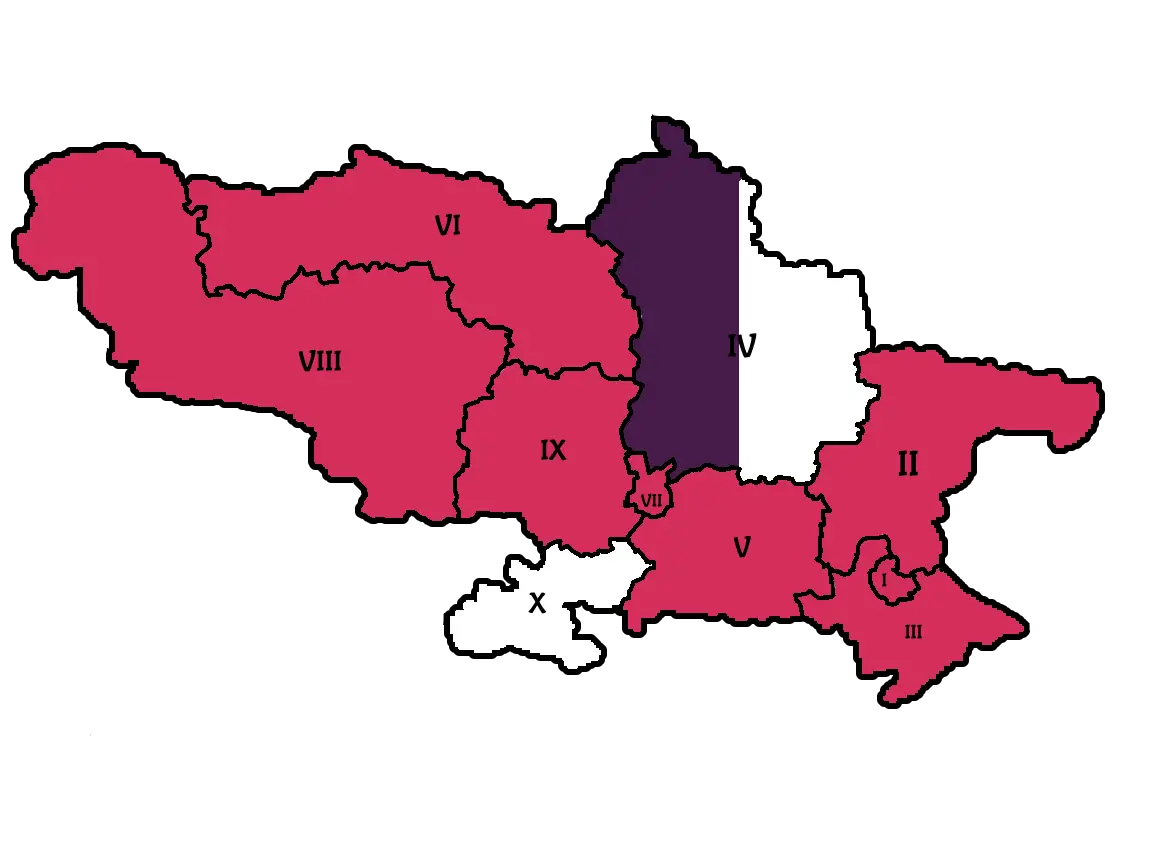
1922 map coloured by party control of districts
| District | Senator | Party | First Elected |
|---|---|---|---|
| I (Sinj) | Ana Kovacevic | Revolutionary People's Party | 1922 |
| I (Sinj) | Filip Novak | Revolutionary People's Party | 1922 |
| II (Kakerovecska) | Touko Lapic | Revolutionary People's Party | 1922 |
| II (Kakerovecska) | Luka Matar | Revolutionary People's Party | 1922 |
| III (Pologradska) | Eward Matek | Revolutionary People's Party | 1922 |
| III (Pologradska) | Marija Sarislav | Revolutionary People's Party | 1922 |
| IV (Severnivaraje) | Antonio Iric | Bistrice People's Party | 1922 |
| IV (Severnivaraje) | Sara Unalina | - | 1922 |
| V (Moskiprovac) | Nika Radman | Revolutionary People's Party | 1922 |
| V (Moskiprovac) | Dora Martinovic | Revolutionary People's Party | 1922 |
| VI (Viskogorje) | Toni Uzela | Revolutionary People's Party | 1922 |
| VI (Viskogorje) | Mia Colak | Revolutionary People's Party | 1922 |
| VII (Ravna Skrad) | Vlade Koci | Revolutionary People's Party | 1922 |
| VII (Ravna Skrad) | Matej Marij Mihaljevic | Revolutionary People's Party | 1922 |
| VIII (Zahodecelska) | Rod Blakojevic | Revolutionary People's Party | 1922 |
| VIII (Zahodecelska) | Marin Lurcic Grubisic | Revolutionary People's Party | 1922 |
| IX (Decelska) | Ivan Franj | Revolutionary People's Party | 1922 |
| IX (Decelska) | Kresimir Basic | Revolutionary People's Party | 1922 |
| X (Moraviskameja) | Ivana Simuna | None - (Affiliated with BRC-21) | 1922 |
| X (Moraviskameja) | Josipa Vukel | None - (Affiliated with BRC-21) | 1922 |
National Results
The following percentages represent each party’s share of the national vote, calculated as the average vote share across all ten districts (each district representing 10% of the population).
| Party | National Vote Share | Change from Previous |
|---|---|---|
| Revolutionary People's Party | 75.8% | - |
| Bistrice People's Party | 3.7% | - |
Breakdown by District
Any incumbent Senators are marked with a *. The two Senators who gained the most vote share in each District were elected to the Assembly. The four candidates who received the most vote share are listed.
District I (Sinj)
District I was the political centre of the new Republic. Filip Novak, the revolution’s principal orator and drafter of the Constitution, topped the poll with 67.1%. He was joined by Ana Kovacevic, a Sinj merchant-family organiser recruited to manage capital ward patronage. The RPP’s combined 79.0% left only token opposition from fellow party candidates and independents; contemporaries treated the district as a coronation of the founding leadership rather than a competitive contest.
| Name | Party | Vote Share | Change | Elected |
|---|---|---|---|---|
| Filip Novak | RPP | 67.1% | - | ✓ |
| Ana Kovacevic | RPP | 11.9% | - | ✓ |
| Tamara Bicanic | RPP | 6.8% | - | |
| Ivana Horvat | - | 4.2% | - |
District II (Kakerovecska)
The industrial north of Kakerovecska returned two RPP founders. Textile industrialist Luka Matar and co-founder Touko Lapic split the vote more evenly than in Sinj — Matar at 35.3% and Lapic at 30.2% — reflecting the district’s merchant and factory interests rather than a single dominant personality. Independent Ivan Marinic polled 13.4% on a platform of tariff moderation, but the RPP’s protectionist line carried the district.
| Name | Party | Vote Share | Change | Elected |
|---|---|---|---|---|
| Touko Lapic | RPP | 35.3% | - | ✓ |
| Luka Matar | RPP | 30.2% | - | ✓ |
| Darko Stipetic | RPP | 21.1% | - | |
| Ivan Marinic | - | 13.4% |
District III (Pologradska)
In Pologradska, constitutional drafter Eward Matek led with 40.7%, followed by Marija Sarislav at 31.5%. All four listed candidates ran on the RPP ticket; Matek’s reputation as author of the Constitution’s civil-rights articles gave him a distinct personal vote beyond party loyalty. The district produced no meaningful opposition slate.
| Name | Party | Vote Share | Change | Elected |
|---|---|---|---|---|
| Eward Matek | RPP | 40.7% | - | ✓ |
| Marija Sarislav | RPP | 31.5% | - | ✓ |
| Ena Bilobrk | RPP | 16.4% | - | |
| Katarina Pavic | RPP | 11.4% | - |
District IV (Severnivaraje)
Severnivaraje was the only district to return a non-RPP party senator. Antonio Iric, who had negotiated the Bistrica Armistice with Novak during the Unification War, won 36.8% for the newly founded Bistrice People’s Party. His district colleague Sara Unalina, an independent regionalist, took 28.6%. RPP candidate Igor Cosic finished third at 20.4%. Iric’s victory established constitutional regionalism as a permitted dissent within the Assembly, distinct from the militant separatism of BRC-21 in the south.
| Name | Party | Vote Share | Change | Elected |
|---|---|---|---|---|
| Antonio Iric | BPP | 36.8% | - | ✓ |
| Sara Unalina | - | 28.6% | - | ✓ |
| Igor Cosic | RPP | 20.4% | - | |
| Bruno Kralj | - | 14.2% | - |
District V (Moskiprovac)
Moskiprovac returned the youngest Divine Founder, Nika Radman, with 49.5% — at 20 years old, the youngest senator ever elected until 1952. He was joined by Dora Martinovic at 34.2%. Both were Novak loyalists from the central logistics hub of Vijrje. Independent challengers split a modest remainder; the district would remain an RPP stronghold for decades.
| Name | Party | Vote Share | Change | Elected |
|---|---|---|---|---|
| Nika Radman | RPP | 49.5% | - | ✓ |
| Dora Martinovic | RPP | 34.2% | - | ✓ |
| Karla Vukovic | - | 10.1% | - | |
| Teo Subotic | - | 6.2% | - |
District VI (Viskogorje)
In Viskogorje, General Loncar’s home district but contested without his candidacy — he remained Councillor for War — Toni Uzela won 57.6% and Mia Colak 23.4% on the RPP ticket. Independent Kresimir Perkovic polled 17.2% on a localist platform. The result reflected the district’s military and university networks’ alignment with the centralist revolution.
| Name | Party | Vote Share | Change | Elected |
|---|---|---|---|---|
| Toni Uzela | RPP | 57.6% | - | ✓ |
| Mia Colak | RPP | 23.4% | - | ✓ |
| Kresimir Perkovic | - | 17.2% | - | |
| Wojcek Rajcar | RPP | 1.8% | - |
District VII (Ravna Skrad)
The border city of Ravna Skrad, a frontline of the Unification War, returned Vlade Koci (38.1%) and Matej Marij Mihaljevic (34.5%). Independent Mil Yalesa took 17.2%, the district’s strongest non-RPP showing outside Severnivaraje and Moraviskameja. Both elected senators would later play contrasting roles in the party splits of the 1930s — Koci to the CRF, Mihaljevic to the Sons of Kresimir.
| Name | Party | Vote Share | Change | Elected |
|---|---|---|---|---|
| Vlade Koci | RPP | 38.1% | - | ✓ |
| Matej Marij Mihaljevic | RPP | 34.5% | - | ✓ |
| Mil Yalesa | - | 17.2% | - | |
| Lana Vukelic | RPP | 10.2% | - |
District VIII (Zahodecelska)
Western Zahodecelska elected Rod Blakojevic (42.4%) and Marin Lurcic Grubisic (30.6%), both RPP candidates with strong ties to the district’s Diviner clergy. Independent Kresimir Baric polled 18.6%. The western provinces would later become a base for the Sons of Kresimir after Basic’s 1924 schism.
| Name | Party | Vote Share | Change | Elected |
|---|---|---|---|---|
| Rod Blakojevic | RPP | 42.4% | - | ✓ |
| Marin Lurcic Grubisic | RPP | 30.6% | - | ✓ |
| Kresimir Baric | - | 18.6% | - | |
| Neven Haluzen | RPP | 8.4% | - |
District IX (Decelska)
Religious hardliner Kresimir Basic won 35.9% in his home district of Decelska, trailing fellow RPP candidate Ivan Franj (39.7%) but taking the second seat. Basic’s sermons against Pravoslavic influence from Moraviskameja had made him a national figure during the war; his relatively close margin against Franj foreshadowed the theological tensions that would split the RPP in 1924.
| Name | Party | Vote Share | Change | Elected |
|---|---|---|---|---|
| Ivan Franj | RPP | 39.7% | - | ✓ |
| Kresimir Basic | RPP | 35.9% | - | ✓ |
| Johann Valak | RPP | 16.4% | - | |
| Petar Simunovic | - | 8.0% | - |
District X (Moraviskameja)
Turnout in Moraviskameja was estimated at 6% of the district population. The Faith Restriction Clause (Article 5, Clause 2 of the Constitution) disenfranchised the Bosken majority, limiting the electorate to Kresimirian-faith adherents and certificate-holders. BRC-21 militants reportedly intimidated Kresimirian voters and suppressed RPP organising; Sinj newspapers also alleged irregularities in ballot handling.
Ivana Simuna (29.9%) and Josipa Vukel (27.3%) won as independents affiliated with BRC-21, edging out RPP candidates Karlo Horvatovic (27.1%) and Antonja Cizmic (15.7%). Both senators held Divinity Certificates obtained through nominal conversion — contemporaries called them “certificates of convenience.” Their election established a pattern of Bosken-aligned representation in a district where the mass population could not vote; Simuna’s 1924 assassination would trigger the Republic’s first constitutional crisis.
| Name | Party | Vote Share | Change | Elected |
|---|---|---|---|---|
| Ivana Simuna | - | 29.9% | - | ✓ |
| Josipa Vukel | - | 27.3% | - | ✓ |
| Karlo Horvatovic | RPP | 27.1% | - | |
| Antonja Cizmic | RPP | 15.7% | - |