Republic Rail (Kresi: Respublika Zeleznica), often abbreviated as RZ, is the state-owned enterprise responsible for the operation of all railway and public bus services within the Divine Republic of Kresimiria.
Established in 1989 following the passage of the State Enterprise Act, Republic Rail holds a constitutionally protected monopoly on rail transport. It is the largest employer in the Kresimirian public sector and serves as the backbone of the nation’s logistics and passenger transit infrastructure.
Novi Otonik serves as the primary operational hub for the RZ Freight division. The city’s massive marshaling yards in Industrial Zone 4 coordinate the flow of raw materials from the northern mines to the city’s steelworks and factories.
History
Formation (1988–1989)
Prior to 1989, the Kresimirian railway network was a fragmented patchwork of aging imperial-era lines, small private operators, and industrial tracks owned by various mining concerns. The rise of private conglomerates in the 1980s, particularly Maj Holdings, threatened to privatize key logistical routes.
Blue Dawn leader Ljubo Sanjakorin, viewing transportation as a strategic national asset, championed the 1988 State Enterprise Act to provide the legal framework for nationalization. Upon the amendment’s ratification, the Council for Development seized all railway assets across the ten districts. On January 1, 1989, these disparate lines were unified under the banner of Republic Rail.
The “Steel Link” Project (1990–1998)
The early years of RZ were defined by Sanjakorin’s “Steel Link” initiative, later named KSO1 (Kresimirian Sinj-Otonik 1). This massive infrastructure project aimed to double-track and electrify the line connecting the political capital, Sinj, with the industrial hub of Novi Otonik.
Despite cost overruns and criticism from the opposition Civic Renewal Front regarding the expense, the KSO1 line opened in 1998. It drastically reduced travel time and facilitated the rapid movement of heavy freight, cementing the state’s role in the industrial economy.
Expansion into Bus Services (2004)
In the early 2000s, under the leadership of Blue Dawn’s Stoyan Vasilis, the government sought to address the lack of public transport in rural districts like Viskogorje and Zahodecelska, where rail infrastructure was sparse.
In 2004, the Assembly passed the Transit Act. This legislation granted Republic Rail the mandate to operate a comprehensive national bus network. RZ absorbed several struggling municipal bus companies and launched the “Republic Coach” service, ensuring that even remote villages had scheduled connections to the rail network. Today, RZ operates the entirety of the nation’s inter-city bus system.
Operations
Rail Services
Republic Rail operates three tiers of train service:
- The Sovereign (Suvereni): High-speed intercity passenger service connecting Sinj, Novi Otonik, and Polograd.
- District Link: Standard passenger service connecting smaller towns and district capitals.
- RZ Freight: The heavy logistics division responsible for moving raw materials, agricultural produce, and military equipment.
The most heavily trafficked and lucrative route operated by the state monopoly is the Trans-Steppe Express. Originating in the industrial heartland, the train makes its final Kresimirian stop at the massive international terminus in the border town of Zavnoherec. Here, the state executes grueling, highly militarized customs and exit-visa checks before allowing the train to proceed into the Republic of Kaskiv. The sprawling maintenance yards surrounding the Zavnoherec station serve as the operational nerve center for the entire eastern rail network.
Bus Services
The RZ bus network acts as a feeder system for the railways. It is heavily subsidized by the state to keep ticket prices low, a policy designed to maintain popularity in rural Blue Dawn strongholds.
Rolling Stock and Fleet
Train Classes
Republic Rail operates a diverse fleet of passenger and freight rolling stock, most of which was domestically manufactured under the KresiTech Railworks program.
| Class | Type | Years in Service | Notes |
|---|---|---|---|
| Class 201 “Silver Pike” | High-speed EMU | 1998–present | Used exclusively on The Sovereign services between Sinj, Novi Otonik, and Polograd; capable of 220 km/h. |
| Class 132 “Gorska” | Mountain-capable DMU | 2007–present | Equipped with reinforced braking systems for steep gradients in Viskogorje and Zahodecelska. |
| Class 088 “Bistrica Heavy” | Electric freight locomotive | 1992–present | Primarily used on ore and coal routes connecting the northern Bistrica mines. |
| Class 041 “Urban Sprint” | Suburban EMU | 2014–present | Short-stop acceleration optimized for District I & II commuter corridors. |
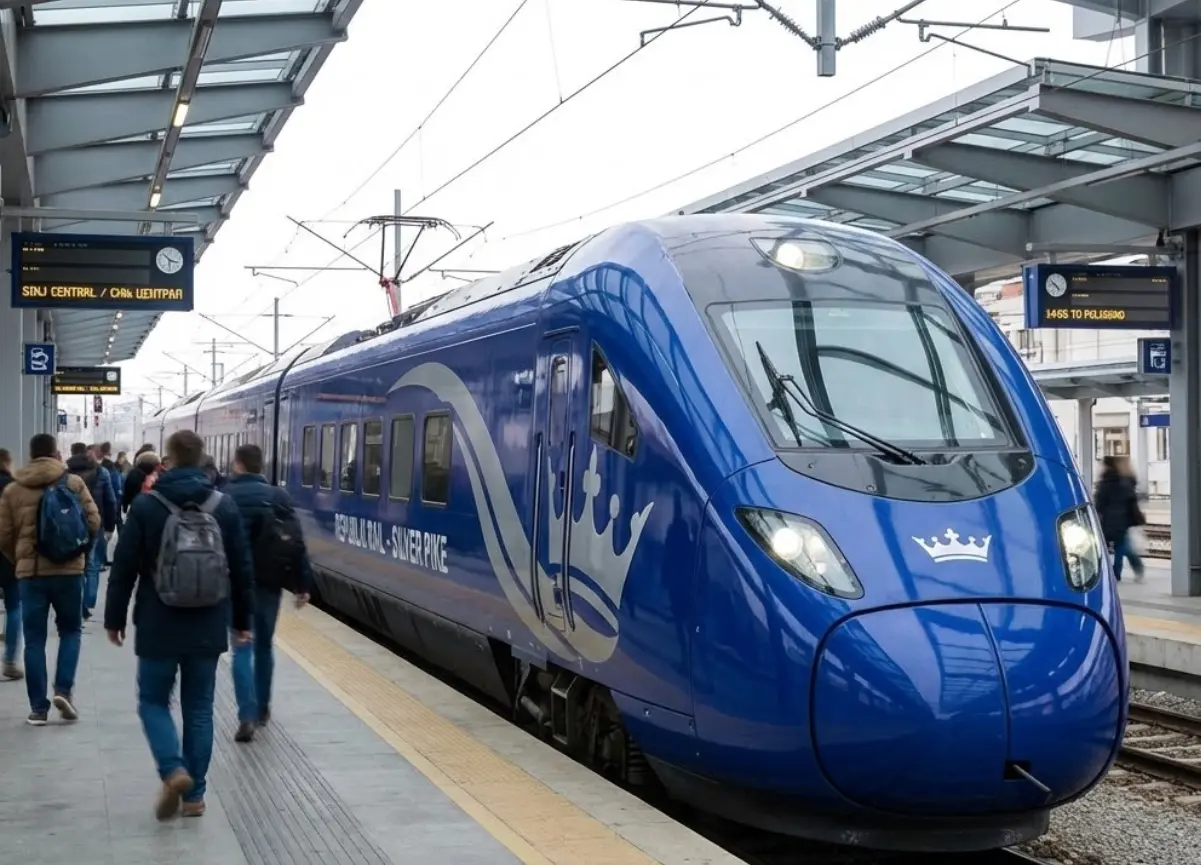 A Silver Pike train at Sinj Central, 2018
Livery and Train Colours
Republic Rail maintains a strict colour-coded identity introduced in 2012 as part of the National Mobility Modernisation Plan:
-
High-Speed “Sovereign” Services: Deep royal blue base with a sweeping silver crown emblem. Represents the “unity of the Republic,” according to the Council for Development.
-
District Link Trains: White body with diagonal green stripes, one stripe for each district served on the line. District X services uniquely use black-and-gold striping for visibility during security inspections.
-
RZ Freight: Matte industrial red with large block “RZ FREIGHT” lettering. Older freight units in Bistrica and Polograd retain pre-1998 grey-and-yellow schemes.
-
Maintenance-of-Way Trains: Bright hazard orange with reflective geometric markings, designed to comply with 2021 railway worker safety regulations.
Timetabling and Service Patterns
Intercity Patterns
The Sovereign services run on a clockface schedule:
-
Sinj → Novi Otonik: Every 30 minutes during peak hours; hourly off-peak.
-
Sinj → Polograd: Every 90 minutes year-round, increasing to hourly during university terms due to demand from Pologradska’s large student population.
-
Night Sovereign: A single overnight service departs Sinj at 00:45, stopping only in Novi Otonik before arriving in Polograd at dawn. It is informally known as the “Scholar’s Train” due to its popularity with long-distance students.
Regional Patterns
District Link services vary depending on geography:
-
Viskogorje – Lipovljana Mountain Line: Every 3 hours, weather permitting; delays are common in winter due to heavy snowfall.
-
Ravna Skrad Corridor: Half-hourly during weekdays, reduced to hourly on Sundays due to the district’s “Quiet Commerce Ordinance,” which limits weekend shop openings.
-
Brod Moravice (District X) Security Window: Passenger trains are only permitted to enter the Bosken border zone during two coordinated “security windows” per day due to the ongoing separatist tension: 06:10, and 13:40.
On-Time Performance
Republic Rail publishes annual punctuality data. In 2024:
- Sovereign: 87.2% on time
- District Link: 92.5% on time
- Freight: 74.1% on time (impacted by congestion around Novi Otonik industrial yards)
Bus Network Branding
Republic Coach Colours
When RZ expanded into road transport in 2004, it adopted a distinct visual identity for its buses to differentiate them from trains:
-
Standard Inter-City Coaches: Forest green with a cream underbelly, symbolizing “land routes connecting the provinces.”
-
Rural Connector Buses: Sunset yellow with wide brown horizontal bands. These are most common in Viskogorje, Zahodecelska, and Severnivaraje.
-
Urban Shuttle Buses (Sinj & Novi Otonik): Charcoal grey with neon teal highlights. Introduced in 2016 to target younger commuters and reduce car usage in District I and II.
-
District X Armoured Coaches: Painted all matte grey with minimal markings for security reasons. They have reinforced paneling and are escorted by the Gendarmerie on certain routes.
Ticketing System
Since 2019, both bus and rail services use the RZ Unified Card (Jedna Karta), a rechargeable smart travel card. The card is district-colour coded:
| District | Colour |
|---|---|
| I – Sinj | Deep Red |
| II – Kakerovecska | Navy Blue |
| III – Pologradska | Forest Green |
| IV – Severnivaraje | Slate Grey |
| V – Moskiprovac | Violet |
| VI – Viskogorje | Alpine Blue |
| VII – Ravna Skrad | Amber |
| VIII – Zahodecelska | Olive |
| IX – Decelska | Burgundy |
| X – Moraviskameja | Black |
Station Architecture and Design
Architectural Styles
Republic Rail maintains several distinct design eras:
-
Imperial Heritage Stations (pre-1920): Ornate stone façades with arched windows; preserved in Sinj Central and Polograd West.
-
Sanjakorin Modernist Stations (1989–1998): Angular concrete structures with minimalist interiors. Criticised for poor heating in winter. Common in industrial nodes like Novi Otonik-South.
-
RZ “Harmony Series” Stations (2010–present): Steel-and-glass pavilions featuring green roofs and solar arrays. Especially notable in Cetingrad and Lipovljana.
Platform Accessibility
A 2023 assessment found:
- 88% of stations fully accessible
- 5% partially accessible
- 7% (all in District X) inaccessible due to ongoing security limitations
Special Services and Unique Features
“Blue Dawn Express”
During election years, Republic Rail operates extra campaign-season specials in District I and V to cope with spikes in travel for rallies and assemblies. Opposition parties allege that schedules are adjusted “strategically” to benefit government turnout, though RZ denies political coordination.
“Bistrica Oreline”
Considered the backbone of Kresimiria’s heavy industry, this freight corridor moves an estimated 68% of the nation’s ore output. Trains can reach up to 2.3 km in length, requiring dual Class 088 locomotives.
“The Panorama”
A tourist-focused seasonal service running through the peaks of Viskogorje between Lipovljana and Cetingrad. Coaches include:
- full-window glass roofs
- slow-speed scenic sections
- locally produced meals onboard sourced from Ravna Skrad farms
Controversies
Rivalry with Maj Holdings
Republic Rail has been locked in a decades-long commercial and political rivalry with Maj Holdings. While RZ has a monopoly on rail freight, Maj Holdings operates Maj Logistics, a massive fleet of commercial trucks.
- The Freight War: In the 1990s, Sanjakorin’s government imposed high tariffs on heavy trucking to force industrial goods onto the state railways. Bran Maj responded by lobbying heavily for deregulation.
- Efficiency: Maj Holdings frequently cites RZ’s bureaucratic inefficiencies and delays as justification for using road transport, despite the higher cost.
1984 Attack
As the primary circulatory system of the Kresimirian economy, the state rail monopoly has frequently been targeted by political extremists. In November 1984, the network suffered one of its darkest days when militants from the Prophet’s Hands bombed the “Faith Line Express” traveling from the southern districts to the capital. The blast derailed the train near Ravna Skrad, killing 12 passengers. The tragedy forced Republic Rail to permanently institute armed CIA transit marshals on all inter-district routes.
The “Ghost Trains” of Moraviskameja
In District X (Moraviskameja), Republic Rail has frequently been a target of sabotage by the terrorist group AFIM. This was a pattern even pre-Republic Rail (notably the 1947 sabotage). Due to security concerns, passenger service in the southern border regions is often sporadic or suspended. The local population often refers to the heavily armored, empty supply trains that run to the military garrisons as “Ghost Trains,” viewing the railway as a tool of Kresimirian military occupation rather than a public service.
Former Republic Rail driver turned Senator Ikka Wallman has used his insider knowledge to become a vocal critic of the company’s operations in Moraviskameja.