This was the second general election to be held since the founding of the Republic in 1921, after the 1922 elections.
The election took place in a political climate marked by factional infighting in the Revolutionary People’s Party (RPP), the party of the state’s founders, which before the election held the majority of seats in the Assembly. The election is notable because it was the first time the RPP lost their majority in the Assembly, winning only 8 out of 20 seats.
Following Basic’s 1924 founding of the Sons of Kresimir, in January 1932, Eward Matek, another one of the six original founders of the Republic, formally established the liberal Civic Renewal Front (CRF). The new party immediately gained a presence in the Assembly when four sitting RPP senators defected to run under its party line in the upcoming elections, causing the RPP to lose its majority in the Assembly.
Resulting Assembly Makeup
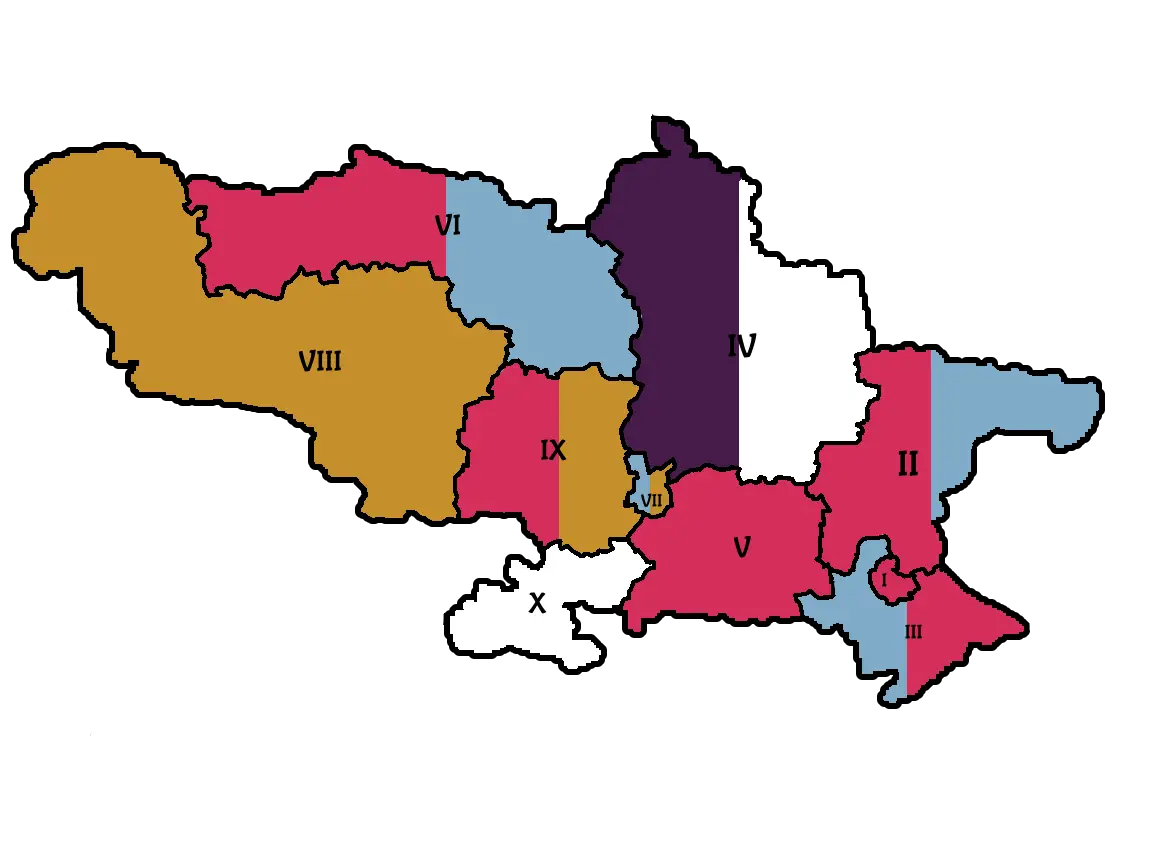
1932 map coloured by party control of districts
Newly elected Senators’ names are highlighted in bold. If a seat was won by a different party, or a Senator changed their party affiliation from the previous election, the party will be highlighted in bold.
The following percentages represent each party’s share of the national vote, calculated as the average vote share across all ten districts (each district representing 10% of the population).
Party
National Vote Share
Change from Previous
Revolutionary People's Party
48.6%
-27.2%
Sons of Kresimir
21.8%
New
Civic Renewal Front
10.7%
New
Bistrice People's Party
4.6%
+0.9%
Northern Power
0.9%
New
Breakdown By District
Any incumbent Senators are marked with a *. The two Senators who gained the most vote share in each District were elected to the Assembly. The four candidates who received the most vote share are listed.
As usual, the turnout in Moraviskameja was extremely low (est. 7% of the population). This was due to the Faith Restriction Clause (Article 5, Clause 2 of the Kresimirian Constitution), which denies the right to vote to anybody who does not follow the Kresimirian faith, excluding the vast Bosken population in the District. Despite this, as in the 1922 and 1924 elections, widespread BRC-21 intimidation and suppression of Kresimirian voters, along with alleged vote manipulation, resulted in the re-election of the two independent Bosken-aligned Senators.